
We currently face numerous environmental challenges – not least meeting the thresholds laid down in France’s RE2020 regulation. So, to reduce the carbon footprint of buildings, using a biosourced material such as timber is a must. And when this timber is local, it brings the added benefit of favouring local distribution networks and supporting the sustainable economy, making it the go-to solution for the buildings of tomorrow.
What are the RE2020 and the 2025 threshold?
The RE2020 is a French energy and environmental regulation which came into force on 1 January 2022. It has gradually replaced the RT2012 and is now a well-established framework for new construction projects.
Unlike former optional environmental labels, the RE2020 sets strict thresholds to reduce the carbon footprint of buildings. It does this through 6 requirements concerning energy, carbon and comfort. The carbon impact requirements include the carbon index threshold (Ic construction), which sets progressive ceilings for CO₂ emissions related to construction materials and processes. This carbon index is calculated by performing a Life Cycle Analysis (LCA) based on the environmental data contained in the EPDs for the building’s components.
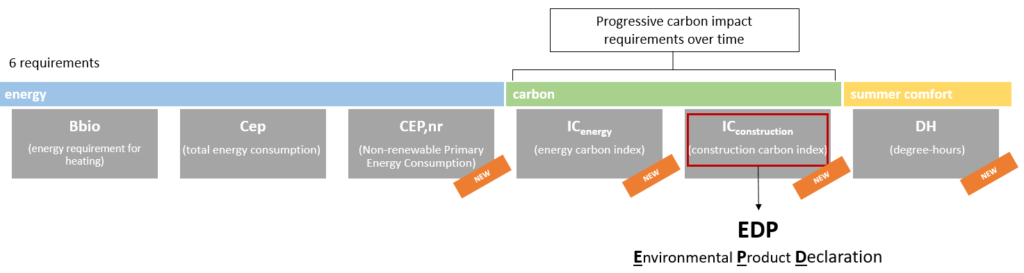
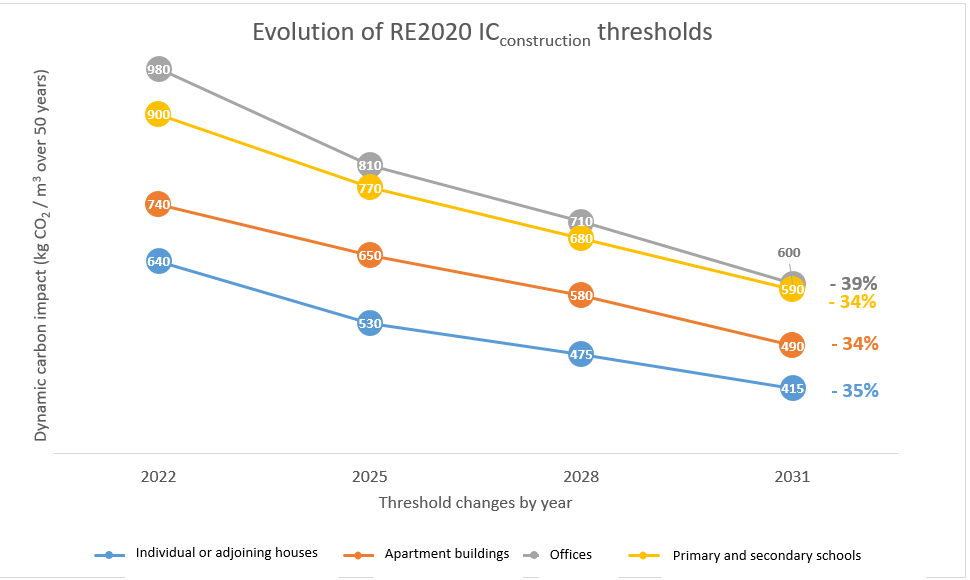
From 1 January 2025, no construction permits will be granted unless the 2025 carbon index threshold is achieved. This drives the construction industry to reduce its use of high-carbon materials in order to improve each building’s carbon impact. As a result, biosourced materials such as timber become not only a responsible choice but also the key to achieving the RE2020 regulation’s aims.
A building’s structure represents almost 30% of its carbon impact, which is why new buildings are being designed with ever more timber content, from timber-framed walls to attics, CLT walls and ceilings, partition walls, and post-and-beam systems.
Between now and 2031, the carbon index must be reduced by 34% to 39% compared with the 2022 threshold, depending on the type of building. These cut-offs force professionals to innovate and adopt increasingly efficient solutions in order to align their projects with crucial carbon-cutting objectives. And to achieve these thresholds, we need to start thinking right now about how we build the buildings of tomorrow.
Why is timber the key to low-carbon construction?
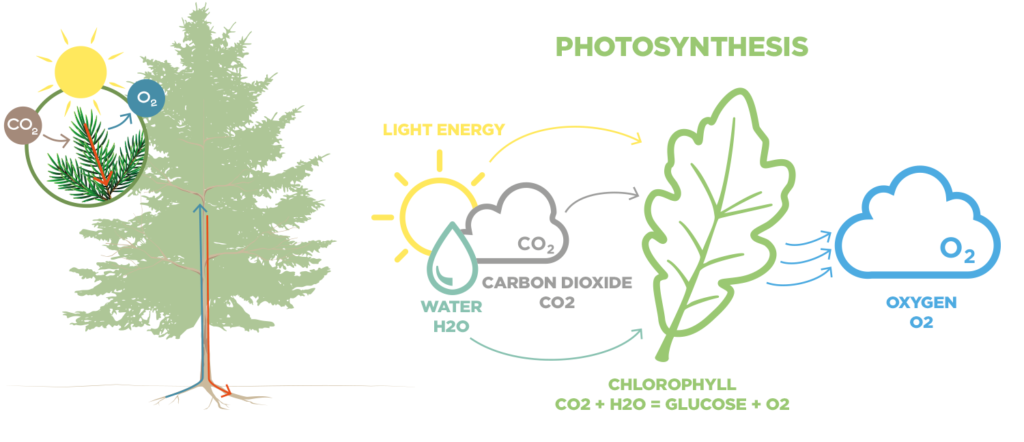
Timber is a biosourced material which, as it grows, stores the carbon present in the atmosphere through photosynthesis.
Photosynthesis is how trees grow. They use sunlight, water and the CO₂ present in the atmosphere to produce glucose – their food source – while storing carbon in their biomass and emitting oxygen.
The carbon that is locked in during the tree’s growth stays there even once it has been cut down, which means that it is stored throughout the life of the building or landscaping project. So, 1m3 of timber stores the equivalent of 1 tonne of CO₂!
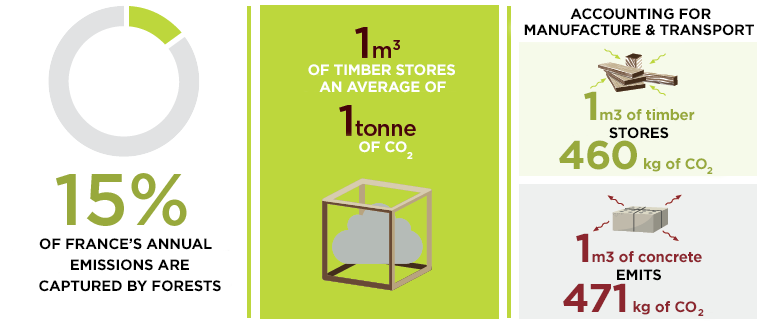
If we are to achieve the carbon index thresholds, it is essential that we increase the amount of timber used in construction.
What is an EPD?
An EPD is an Environmental Product Declaration.
It is a standardised document that summarises the environmental and health impacts of a construction product.
This information can be used to help choose between different options. EPDs are particularly useful within the context of the RE2020 as they are used to carry out a building’s LCA, which determines the building’s carbon index (Ic construction).
All French EPDs can be found on the inies.fr national database.
There are 3 types of EPD:
Individual EPD: produced by a manufacturer for a product.
Collective EPD: produced by professional bodies for a family of products within their industry (e.g. French timber cladding)
DED: Donnée Environnementale par Défaut (default environmental data), which is used when there is no EPD for the product in question. These are created by the French Ministry for the Ecological Transition.
Which EPD indicators are taken into account when it comes to construction labels and the RE2020?
Biogenic carbon storage: for construction labels
What is boigenic carbon storage?
This indicator refers to the carbon that is sequestered and stored by biosourced materials, such as wood, as they grow. It is expressed in kilogrammes of carbon or CO₂ per functional unit (kg C / FU or kg CO₂ / FU). The FU may be m², m³, etc.
Where can this indicator be found?
It can be found on the inies.fr database by going to the EPD in question (known in French as an FDES) then clicking the Indicateurs tab > Stockage de carbone biogénique.
What is the biogenic carbon storage indicator?
Storing carbon in long-lasting materials such as construction materials offsets a share of the emissions generated by the construction process and by transporting other, non-biosourced materials. It is essential to know the biogenic carbon storage indicator in order to meet the requirements of environmental labels and the growing demand for low-carbon buildings. This indicator is needed by anyone in the construction industry seeking to prove and quantify the ecological aspect of their projects and promote local, environmentally friendly materials.
The global warming index (or climate change index): for calculating the RE2020 carbon index
This indicator measures the carbon impact of materials. A static version can be found in the material’s EPD. It is expressed in equivalent kilogrammes of CO₂ per functional unit (kg eq CO₂ / FU).
In EPDs drawn up under standard EN 15804 +A1, the term “global warming” is used, while for EPDs drawn up since the new +A2 version came into force, “climate change” is used. You can find it by going to the relevant EPD on the inies.fr website, then clicking the Indicateurs tab > Impacts environnementaux. The indicator to look for is the Total cycle de vie (life cycle total).
Under the RE2020 environmental regulation, when performing the building’s Life Cycle Analysis (LCA), the calculation software automatically converts this static data into dynamic data. This conversion is crucial because it more accurately reflects the real impact of biosourced materials.The dynamic LCA assigns greater weight to the greenhouse gases produced at the start of the building’s life because those are the ones that stay in the atmosphere for the longest. This assessment method reflects the urgency of reducing current emissions to aid the fight against climate change. It also takes into account the uncertainty over what happens to materials at the end of their lives, and over how greenhouse gases actually break down in the atmosphere.

Biosourced materials = negative carbon impact!
Unlike other construction materials, biosourced materials such as timber store carbon throughout the product’s life. As a result, the dynamic data for biosourced materials eventually become negative, meaning that these products sequester more carbon than they emit. This actively reduces greenhouse gas emissions throughout the building’s lifespan.
Environmental impacts in figures
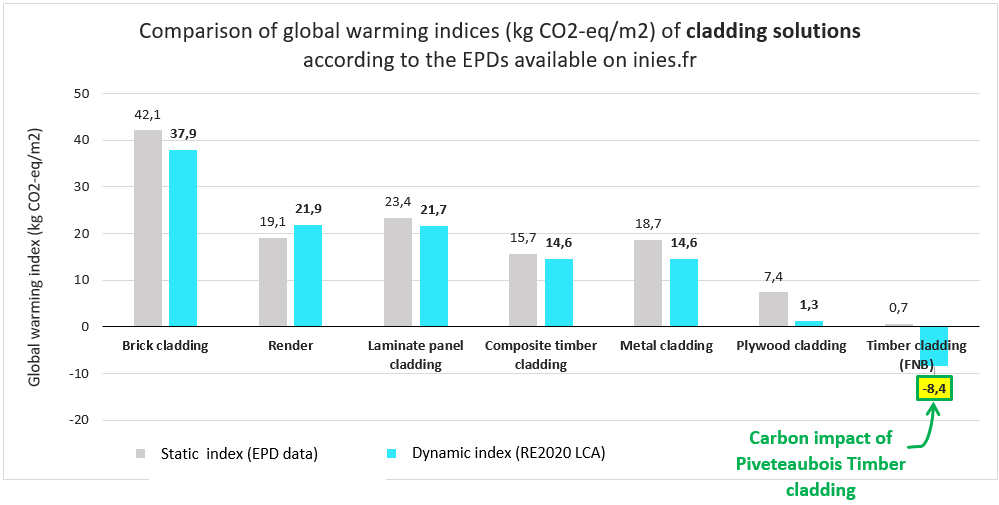
The graphs below show the actual impact of products as assessed by the Life Cycle Analysis (LCA) required under the RE2020 regulation. When carrying out the LCA, it is essential to consult the dynamic indicators.
Comparing the carbon impact of materials: external cladding
Choosing timber cladding rather than another material considerably reduces the carbon impact and achieves a negative carbon impact, highlighting timber’s status as a low-carbon and carbon-sequestering material, which makes it a far better choice for the environment than alternatives.
Comparing the carbon impact at the construction system level: straw bales vs concrete
Vizcab.io is a software platform for measuring and forecasting the carbon impact of construction.
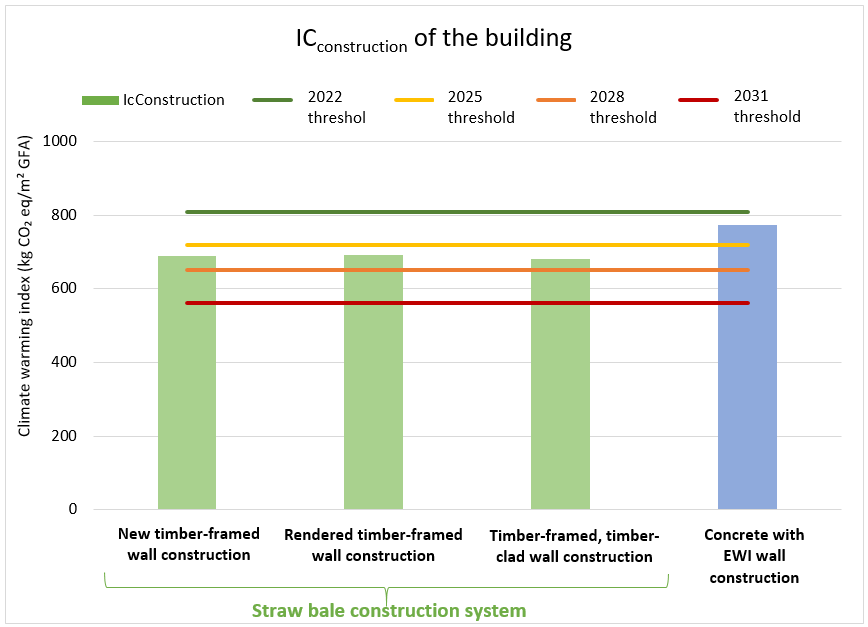
We have used Vizcab to perform RE2020 LCA calculations for a 2-storey apartment building consisting of 24 apartments, one penthouse apartment and a 30-space underground car park.
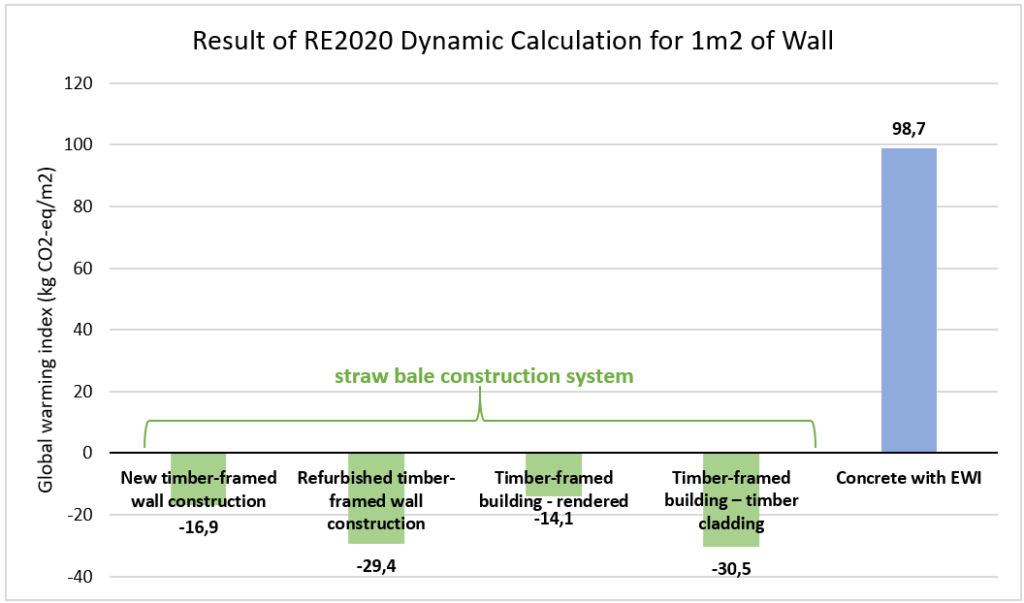
At the construction system level, all straw bale systems sequester more carbon than they emit, unlike the concrete with EWI system. Opting for a straw bale solution rather than concrete with EWI reduces the carbon impact of a 6-sided building by 30% to 35%.
By knowing a product’s environmental performance, you can optimise the performance of your construction system so as to achieve the carbon index thresholds. Explore 3 different biosourced, low-carbon wall and facade systems in our design guide.
Comparing the carbon impact at the building level: straw bales vs concrete
At the building level, opting for straw bales over concrete with EWI reduces the project’s overall LCA by 10% to 12%. The carbon indices obtained all comply with the 2022 threshold. However, the concrete with EWI solution does not meet the 2025 threshold without other offsetting solutions, and further improvements are needed to meet the 2028 and 2031 thresholds no matter the construction solution.
Focus on CLT
When used in a building that is subject to the RE2020, our Piveteaubois Hexapli CLT has the lowest dynamic carbon impact on the market, mainly because it uses pine – a species that is very dense, which increases its carbon storage capacity. Manufacturing it in France from local timber sourced from French forests also helps to explain its exceptionally low carbon impact.
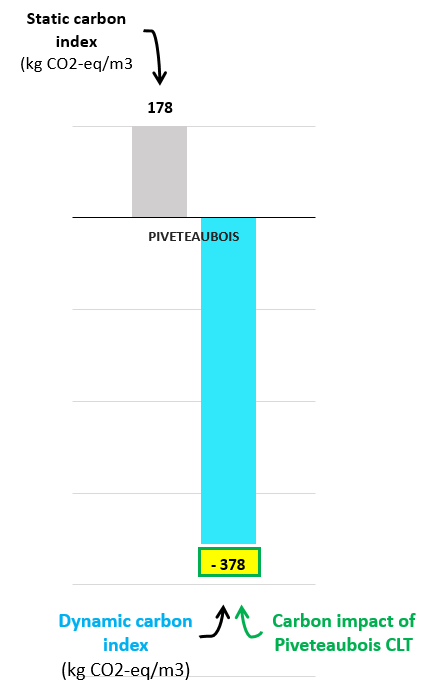
All of the results can be found in the EPD available at inies.fr and in our EPD guide.
Focus on Glulam
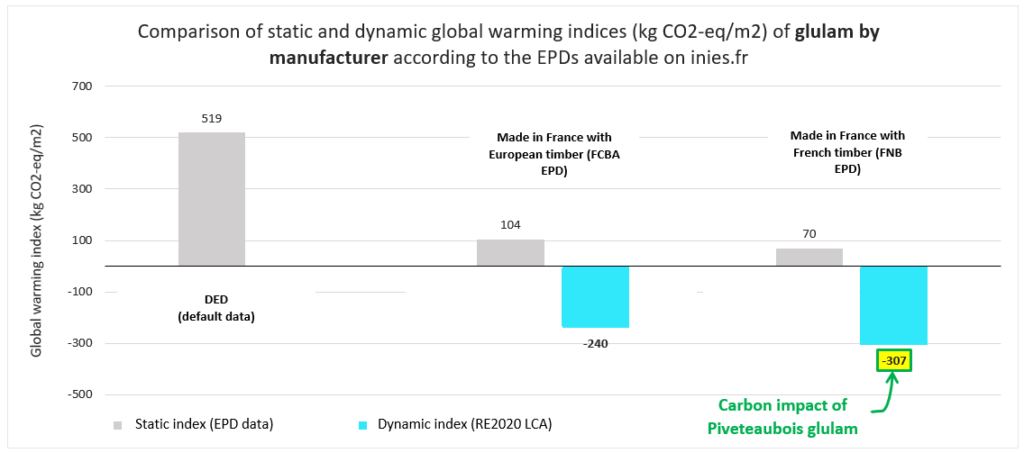
For glulam, Piveteaubois refers to the EPD created by the FNB (French National Timber Federation). Non-French manufacturers without an individual EPD must use the default environmental data (DED), which is often less complimentary. In addition, opting for French timber for French construction projects, rather than timber from elsewhere in Europe, reduces the carbon impact of glulam by a further 28%.
How do you select the right EPD for Piveteaubois products?
Several EPDs apply to any one type of product. Optimising the choice of construction material by selecting those with the best environmental data can be decisive for achieving the desired carbon index performance.
Our Piveteaubois interactive guide can help you choose the most appropriate EPD from the French government database on inies.fr. Just click here.
SUMMARY: 4 TIPS FOR DECARBONISING CONSTRUCTION AND ACHIEVING THE RE2020 CARBON INDEX THRESHOLDS.
① Wherever possible, use biosourced materials such as timber, and biosouced construction systems such as straw bales
② Prioritise local timber
③ Look at the dynamic indicators when comparing solutions
④ Choose the right EPD: use the Piveteaubois guide to help you